Why Windscreen Rubber Seals Fail in Sydney's Eastern Suburbs
Most drivers in the Eastern Suburbs don't think about the rubber seal running around the edge of their windscreen until something goes wrong. By then, it's usually leaking water into the cabin, making a persistent whistling in the wind on the Eastern Distributor, or quietly allowing moisture to work its way into the body panels around the A-pillar.
The rubber seal, sometimes called the windscreen gasket or weatherstrip, is doing more work than it gets credit for. And if you park regularly in Bondi, drive along the coast through Maroubra or Coogee, or live anywhere in Sydney's Eastern Suburbs where your car sits exposed to the sea air, your seals are under more stress than they would be five kilometres inland.
What the Rubber Seal Actually Does
Before getting into why seals fail in this environment, it helps to understand what they're doing in the first place. The rubber seal around your windscreen serves four functions simultaneously.
It creates a watertight barrier between the glass and the car's body frame, keeping rain, road spray, and car wash water out of the cabin. It acts as a noise buffer, absorbing vibration between the rigid glass and the metal frame so you don't hear every bump and wind gust amplified through the A-pillar. It provides a cushioning layer that protects both the glass and the frame from direct contact, reducing the chance of stress cracks from road vibration. And in modern vehicles, it contributes to the structural bond between the windscreen and the body, which is relevant in a collision because the windscreen provides roof support and airbag backstop.
When the seal fails, all four of these functions degrade. The consequences go beyond a damp floor mat.
Why the Eastern Suburbs Environment Is Harder on Rubber Than Most of Sydney
Rubber seal deterioration happens everywhere, but it accelerates under specific environmental conditions. The Eastern Suburbs check more of those boxes than most Sydney postcodes.
Salt air off the coast.
Bondi, Bronte, Coogee, Maroubra, Clovelly, all of these suburbs sit within direct salt air exposure from the Pacific. Salt is corrosive to rubber over time. It draws moisture into the rubber's structure, accelerates oxidation, and causes the material to become brittle faster than it would in an inland environment. Cars parked in the open near the beach, Bondi Beach car park, the Coogee foreshore, and Maroubra beach parking are exposed to this consistently.
Intense UV exposure.
Rubber is vulnerable to ultraviolet light. UV breaks down the polymer chains that give rubber its flexibility, causing it to harden, crack, and shrink. Sydney's UV index is already high relative to most of the world, and in the Eastern Suburbs, where there's less shade from dense inland vegetation and more open coastal sky, dashboard and seal surfaces face prolonged, direct UV exposure year-round.
Temperature swings.
A car parked in full sun at Bondi Beach on a summer afternoon will have a windscreen surface temperature well over 60°C. The same car driven to a shaded Randwick side street cools rapidly. Rubber expands and contracts with temperature repeatedly over years; this cycle fatigues the material and weakens the bond between the seal and the glass or frame it's pressed against.
Sea spray and pressure washing.
Drivers who regularly clean salt buildup off their car using high-pressure washing can inadvertently force water under degraded seals or dislodge sections that are beginning to lose their adhesion. Once water gets behind the seal, it sits against the frame and accelerates both rust and further seal degradation. None of this is dramatic or unusual. It's just the normal physics of that environment applied to a component that has a finite lifespan and is shortened by the local conditions.
Signs Your Windscreen Seal Is Failing
The tricky thing about seal failure is that it tends to be slow and easy to rationalise. The first signs are subtle, and by the time drivers notice them clearly, the seal has usually been compromised for some time.
Water inside the cabin after rain.
If you're finding wet patches on the dashboard near the windscreen base, damp carpet in the footwell, or moisture on the inside of the glass after heavy rain, water is getting in somewhere. The windscreen seal is the first place to check, though the A-pillar seal and sunroof drain (if applicable) are also candidates.
Wind noise at highway speed.
A properly sealed windscreen should be acoustically quiet. If you're hearing a whistle or rushing air sound at 80–100km/h on the Eastern Distributor or the M1 and it seems to come from around the windscreen frame, the seal is no longer making full contact with the glass or body edge.
Visible cracking or shrinkage in the rubber.
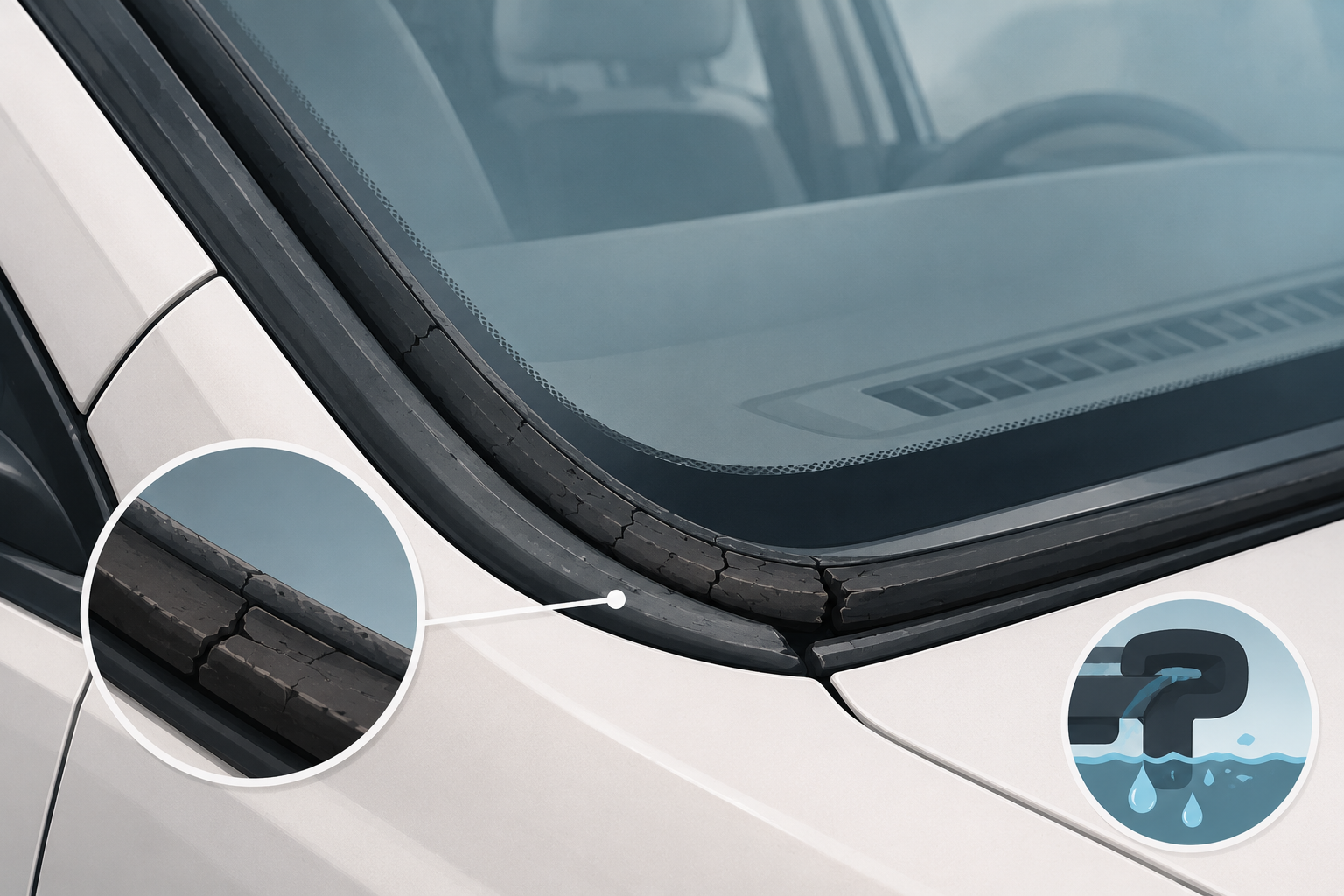
Look at the rubber trim around the outside edge of your windscreen. If it's visibly cracked, brittle, pulling away from the glass at any point, has turned noticeably darker or harder than it once was, or has small gaps appearing between the rubber and the glass edge, the seal is deteriorating. In early stages this is cosmetic; left longer, it becomes a leak path.
Fogging on the inside of the windscreen that won't clear.
Persistent interior fogging, particularly in the lower corners of the glass, can indicate moisture getting into the cabin through a compromised seal. The moisture evaporates slowly and condenses on the cold glass surface.
Water staining along the windscreen base or inside the A-pillar trim
Remove the A-pillar trim piece and look for tide marks, rust staining, or softness in the underlying panel. These are signs that water has been running in along the windscreen edge for some time.
What Happens If You Leave a Failing Seal
A windscreen seal that's starting to fail but hasn't caused a noticeable leak yet is easy to put off. The problem is that the consequences compound over time.
Water that gets past the seal doesn't evaporate cleanly. It runs down channels in the body cavity, sits against metal, and starts to rust. Around the A-pillar and windscreen frame structural parts of the car, rust is not a minor issue. Treating surface rust around a windscreen frame is substantially more involved than a simple reseal, and in advanced cases it can affect the structural integrity of the windscreen surround itself, which changes what the repair involves and what it costs.
There's also the glass bond to consider. Modern windscreens aren't just held in by rubber; they're adhesively bonded to the frame using urethane. A deteriorating outer rubber seal allows moisture to work back toward that adhesive bond. Over time, the bond weakens, which affects how the windscreen performs structurally in a collision.
And for cars with ADAS cameras or sensors mounted at the top of the windscreen, which covers most vehicles made after 2018, moisture intrusion near the camera housing affects sensor accuracy and can trigger calibration faults.
Early resealing is almost always cheaper and simpler than dealing with any of these downstream consequences.
What's the Difference B/W Rubber Resealing vs Full Windscreen Replacement
The question most drivers ask when they first notice a seal issue, and the answer depends on the condition of the glass and the extent of the seal damage.
Rubber resealing is the right option when the windscreen itself is in good condition, no cracks, chips in the line of sight, or damage to the glass, but the rubber trim or adhesive around the perimeter has deteriorated. The technician removes the damaged seal material, prepares the surface, and applies fresh sealant or installs new rubber trim, restoring the watertight and acoustic barrier without touching the glass.
This is a faster, more affordable job than replacement and is entirely appropriate when the problem is the seal itself rather than the glass. The rubber resealing service covers this in detail, including what the process involves and what it costs.
Full windscreen replacement becomes necessary when the glass itself is damaged, cracked, or chipped in a way that compromises vision or cannot be repaired, or when the existing windscreen has been in place so long that the adhesive bond has significantly degraded. In these cases, the glass comes out, the frame is cleaned and prepared, and a new windscreen is installed with fresh adhesive and trim. For help working out which situation applies to your glass, this guide on repair vs replacement walks through the decision criteria clearly.
If you're not sure which applies to your car, a mobile technician can assess it on-site. In most cases, it's clear within a few minutes of looking at the seal condition and glass.
Can You Reseal a Windscreen Yourself?
Hardware stores and auto parts shops sell windscreen sealant products, and the process looks simple enough on paper, clean the gap, apply the sealant, let it cure. The reality is more nuanced.
The main issue is preparation. For a reseal to hold properly, the old sealant has to be fully removed and the bonding surface has to be clean, dry, and free of oxidation or contamination. Incomplete removal of old sealant creates an uneven surface that the new material won't bond to correctly, leaving gaps and weak points that will allow water through again quickly.
The second issue is material selection. Automotive urethane sealants behave differently from general construction silicone, they cure differently, have different adhesion properties, and some are not compatible with the materials used in the windscreen frame. Using the wrong product results in a seal that looks correct but fails faster than the original.
A professional reseal uses automotive-specific materials applied to a properly prepared surface, which is why the result holds. For a mobile job across the Eastern Suburbs,
Randwick,
Rose Bay,
Woollahra,
Bondi Junction, the technician brings all materials and does the preparation on-site. The
front windscreen replacement page also notes the importance of correct adhesive application for anyone wanting to understand what the installation process involves.
Frequently Asked Questions
How long does a windscreen reseal take?
Most resealing jobs are completed in under an hour on-site. The curing time depends on the sealant used, but in most cases, the car is drivable within 30 to 60 minutes.
Will my insurance cover windscreen resealing?
Many comprehensive policies cover windscreen-related repairs, including resealing. It's worth checking your policy or calling your insurer before paying out of pocket; some cover it with no excess.
How long should a windscreen seal last?
In typical conditions, 10 to 15 years. In coastal environments like the Eastern Suburbs with consistent salt air and UV exposure, seal life is commonly shorter. If your car is more than 8 years old and has spent most of its life parked near the coast, the seal is worth inspecting.
My windscreen doesn't leak. Does the seal still need attention?
Not necessarily immediately, but visible cracking or shrinkage in the rubber trim is a sign that deterioration has started. Getting it checked before it starts leaking is consistently cheaper than dealing with it after water has already been getting in.
Is wind noise always a seal problem?
Not always, door seals, sunroof drains, and roof rack mounts can all cause wind noise. But noise that sounds like it's coming from the front of the cabin around the windscreen frame is the seal until proven otherwise.
The rubber seal around your windscreen is a relatively small component doing significant work, and the Eastern Suburbs environment- salt air, UV, coastal temperature cycles, shortens its lifespan compared to inland Sydney. The signs of failure are easy to miss until water starts appearing somewhere it shouldn't.
Eastern Suburbs Windscreens provides mobile rubber resealing and windscreen services across Bondi, Randwick, Maroubra, Rose Bay, Paddington, Woollahra, Bondi Junction, and surrounding suburbs. If your windscreen is making wind noise, showing water inside the cabin, or the rubber trim is visibly cracked, get it looked at before it becomes a larger repair.
Recent Posts