Windscreen Chip or Crack? Here's Exactly When to Repair and When to Replace
Windscreen Chip or Crack? When to Repair and When to Replace in Sydney's Eastern Suburbs
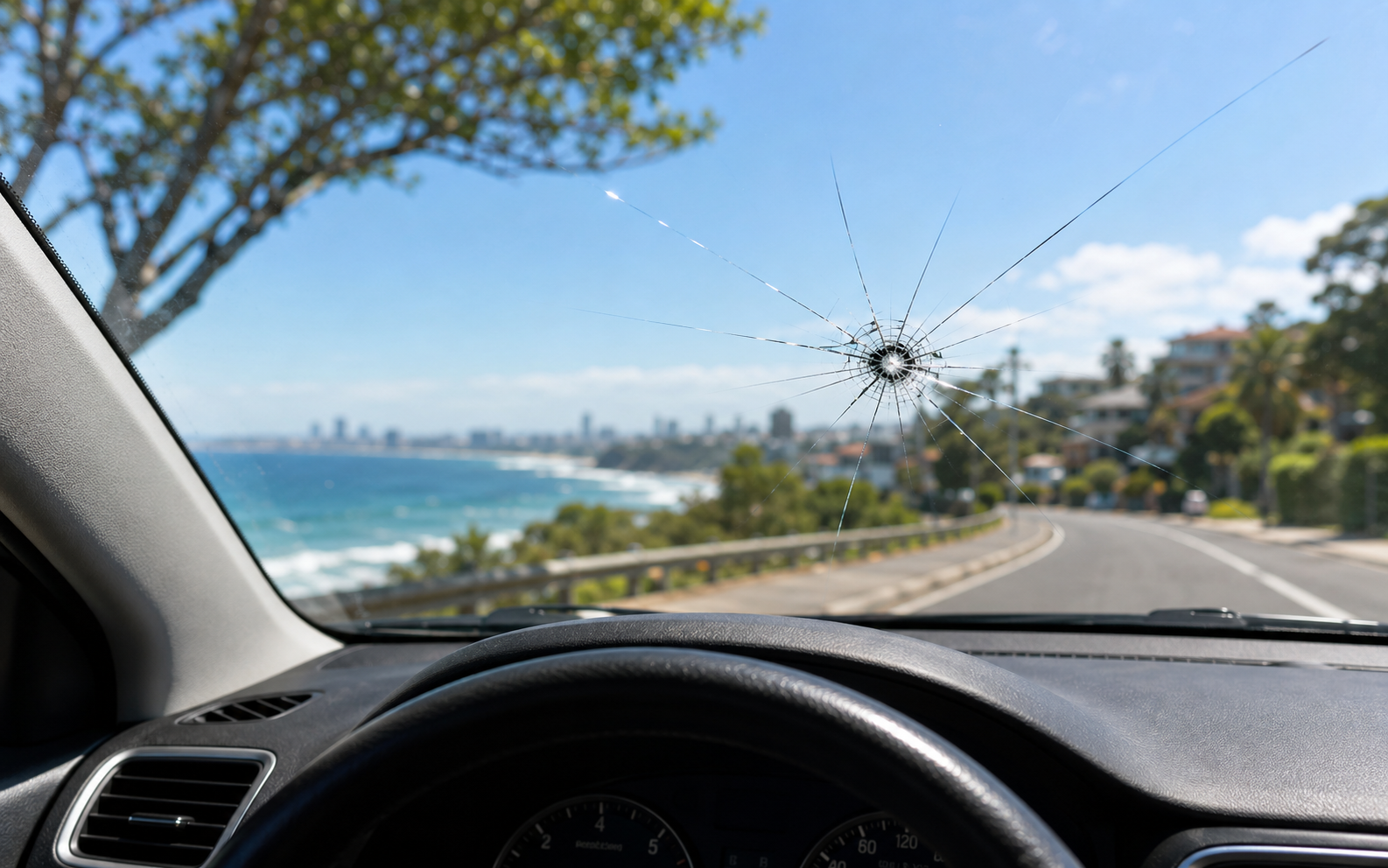
A stone hits your windscreen on the Eastern Distributor. You hear the crack. You pull over, look at it, and the damage seems small. Now you're wondering, do I actually need a full replacement, or can this be fixed?
It's the most common question we get. And the honest answer is: it depends on four things. Size, depth, location, and how long you wait.
Get those four things right and you could save yourself $300 or more by opting for a repair instead of a replacement. Get them wrong or wait too long and a $99 chip repair becomes a $400 windscreen replacement.
Why Your Windscreen Matters More Than You Think
Before getting into the repair vs replace decision, it's worth understanding what your windscreen actually does. Most people think of it as just a big piece of glass that keeps the wind out. It's not.
Your windscreen contributes significantly to the structural strength of your car. In a rollover accident, it helps prevent the roof from caving in. It also supports correct deployment of the passenger airbag, if the windscreen isn't properly bonded to the frame, the airbag can push out through the glass instead of inflating into the cabin the way it's designed to.
That's why in NSW, driving with a windscreen that obstructs your vision or compromises structural integrity is illegal. It's not just a fine risk, it's a genuine safety issue.
A chip or crack that looks minor on the surface can matter a lot depending on exactly where it is and how deep it goes.
The Four Things That Determine Repair vs Replacement
1. Size
As a general rule, chips smaller than a 10-cent coin and cracks shorter than 75mm can usually be repaired. Once a crack goes past roughly 10–15cm, repair resin can't fully restore the glass's structural strength, and replacement is the safer call.
That said, size is just one factor. A 6cm crack in the wrong location can be more serious than a 10cm crack in the right one.
2. Depth
Your windscreen is laminated, two layers of glass bonded around a plastic interlayer (called PVB). Repair works by injecting resin into damage that's confined to the outer glass layer. Once the damage penetrates through to the interlayer or inner layer, the glass's structure is compromised in a way resin can't fix.
If you run your fingernail across the chip and it catches in a groove, the damage likely goes deeper than the surface. That's a sign that replacement may be needed regardless of size.
3. Location
The driver's line of sight is roughly the area swept by your wipers directly in front of the steering wheel. Any repair in this zone leaves a slight blemish, even a perfect repair. If it's subtle and off to the side, most drivers adapt without issue. If it's right in your central vision, it can create distortion that's distracting and potentially dangerous. In that case, replacement is the right choice even if the chip is technically small enough to repair.
The edges of the windscreen are the other critical zone. A crack that starts within 5cm of the edge, or reaches the edge, compromises the bond between the glass and the frame. That bond is part of what keeps the windscreen in place in a collision. Edge cracks almost always require replacement.
Away from the edges and out of the driver's direct line of sight is the best-case scenario for repair. A chip in the top corner, or on the passenger side away from the wiper zone, is usually straightforward to fix.
4. How Long You've Waited
This one catches people out more than anything else. A chip that was repairable on Monday can become non-repairable by Friday.
Sydney's Eastern Suburbs has a coastal climate, humidity, salt air, and significant temperature swings between day and night. All of these accelerate crack growth. Moisture gets into the crack and weakens the interlayer. Thermal expansion from a hot afternoon followed by cooler sea breeze conditions causes the glass to flex, driving the crack further. The vibration from driving, speed bumps on Anzac Parade, potholes near Maroubra, the rough surface on some Randwick streets, does the same thing.
What looks like a stable 30mm chip in the morning can be a 100mm crack by evening. Once that happens, the repairable window is closed.
Which option is better: Repair or Replace?
| Situation | Repair | Replace |
|---|---|---|
| Chip smaller than a 10-cent coin | ✓ Usually | |
| Crack under 75mm, away from edges | ✓ Usually | |
| Crack in driver's direct line of sight | ✓ Recommended | |
| Crack within 5cm of windscreen edge | ✓ Required | |
| Crack over 15cm long | ✓ Required | |
| Multiple chips or spreading damage | ✓ Required | |
| Damage penetrates inner glass layer | ✓ Required | |
| Car has ADAS cameras (lane assist, auto braking) | Depends | Often ✓ |
What About ADAS? (Modern Cars with Driver Assistance Tech)
If your car was built after 2015 and has features like lane-keeping assist, automatic emergency braking, adaptive cruise control, or rain-sensing wipers, there's almost certainly a camera mounted behind your windscreen.
That camera is calibrated to read the road through a specific section of glass. Even a repair in or near that area and especially a full replacement, can affect how the camera sees. After any windscreen replacement on an ADAS vehicle, recalibration of that camera system is required. Without it, your safety systems may give false readings, fail to engage, or worse, engage incorrectly.
Always confirm before booking whether your vehicle requires ADAS recalibration, and whether that's included in your quote. On a replacement job, it should be.
What Actually Happens During a Chip Repair
A chip repair involves injecting a clear, UV-cured resin into the damaged area using a vacuum tool. The vacuum draws out any air trapped in the chip, then the resin is pressed in under controlled pressure to fill the void completely. UV light then cures and hardens the resin to restore the glass's structural strength.
Done well, a chip repair restores around 90–95% of the original glass strength and stops the damage from spreading. The repair site is usually barely visible, particularly in good light on a clean windscreen.
Done badly, with cheap resin or inadequate vacuum technique, air bubbles get trapped, the resin yellows over time, and the repair can fail within months. This is why DIY windscreen repair kits, while cheap, produce consistently poor results compared to professional repairs. The resin quality is lower and the vacuum tool is basic. Most DIY repairs either don't hold or leave visible distortion that would have been avoided with a proper fix.
What Actually Happens During a Windscreen Replacement
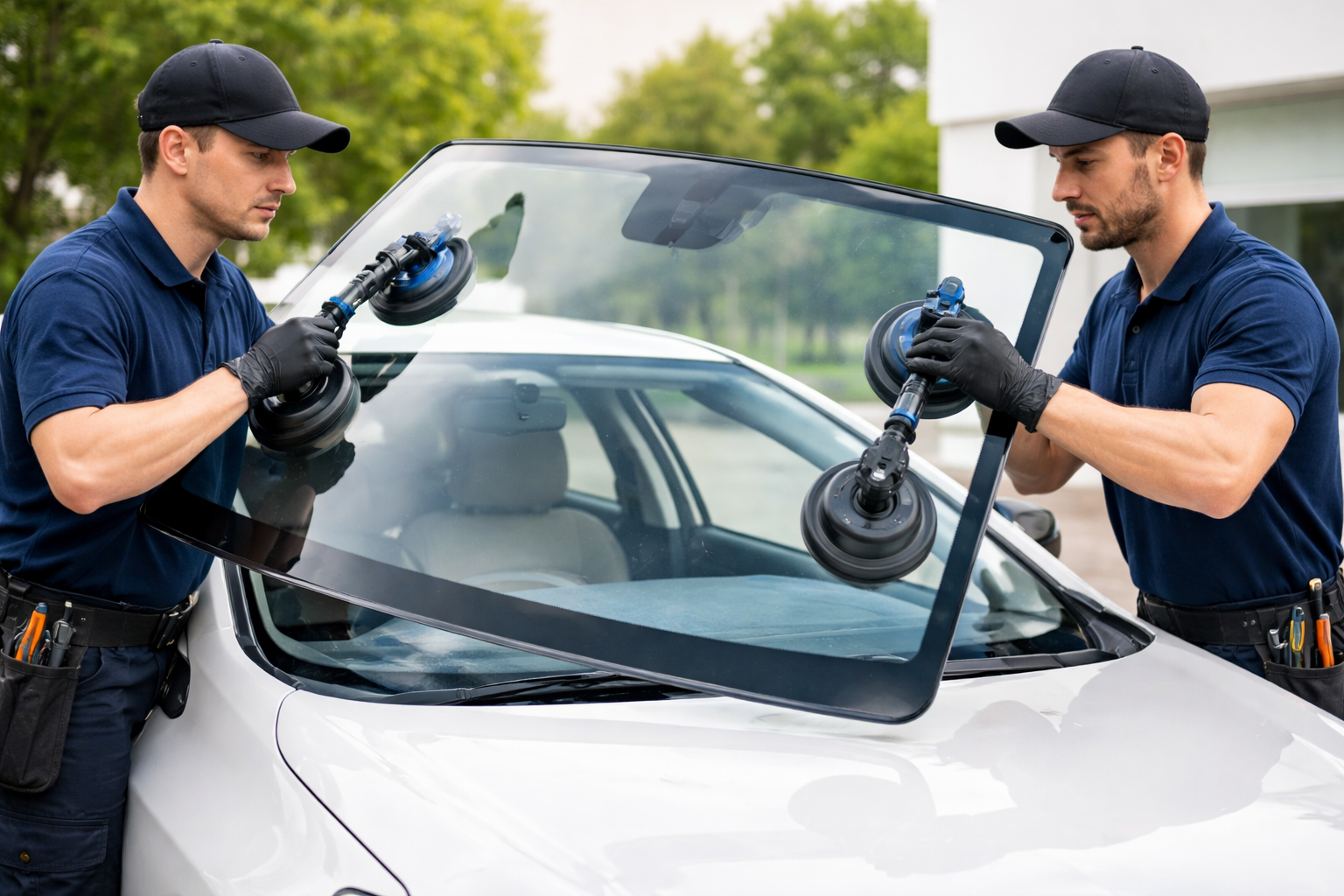
The old windscreen is removed, the frame cleaned of old adhesive and primer, and any rust or corrosion treated. New adhesive, a high-strength urethane specifically rated for automotive bonding, is applied to the frame, and the new glass is positioned and pressed into place.
The adhesive has a cure time. Most modern urethane adhesives used by professional technicians are fast-curing, typically reaching safe drive-away strength within 30–60 minutes. But "safe drive-away" doesn't mean fully cured, for the first 24 hours, avoid car washes, high-pressure water near the seal, and slamming doors hard, as these all stress the fresh bond.
The reason the cure time matters: if you drive on a windscreen that hasn't properly bonded, the seal can fail, allowing water leaks and critically, the structural support the windscreen provides in a collision won't be there.
A properly installed windscreen on a standard vehicle takes 60–90 minutes from start to finish for the replacement itself. Add time for ADAS recalibration on cars that need it.
Driving in the Eastern Suburbs Doesn't Help Your Windscreen
If you've noticed your windscreen seems to take a beating compared to friends in other parts of Sydney, you're not imagining it.
The Eastern Suburbs has a few specific conditions that accelerate windscreen damage:
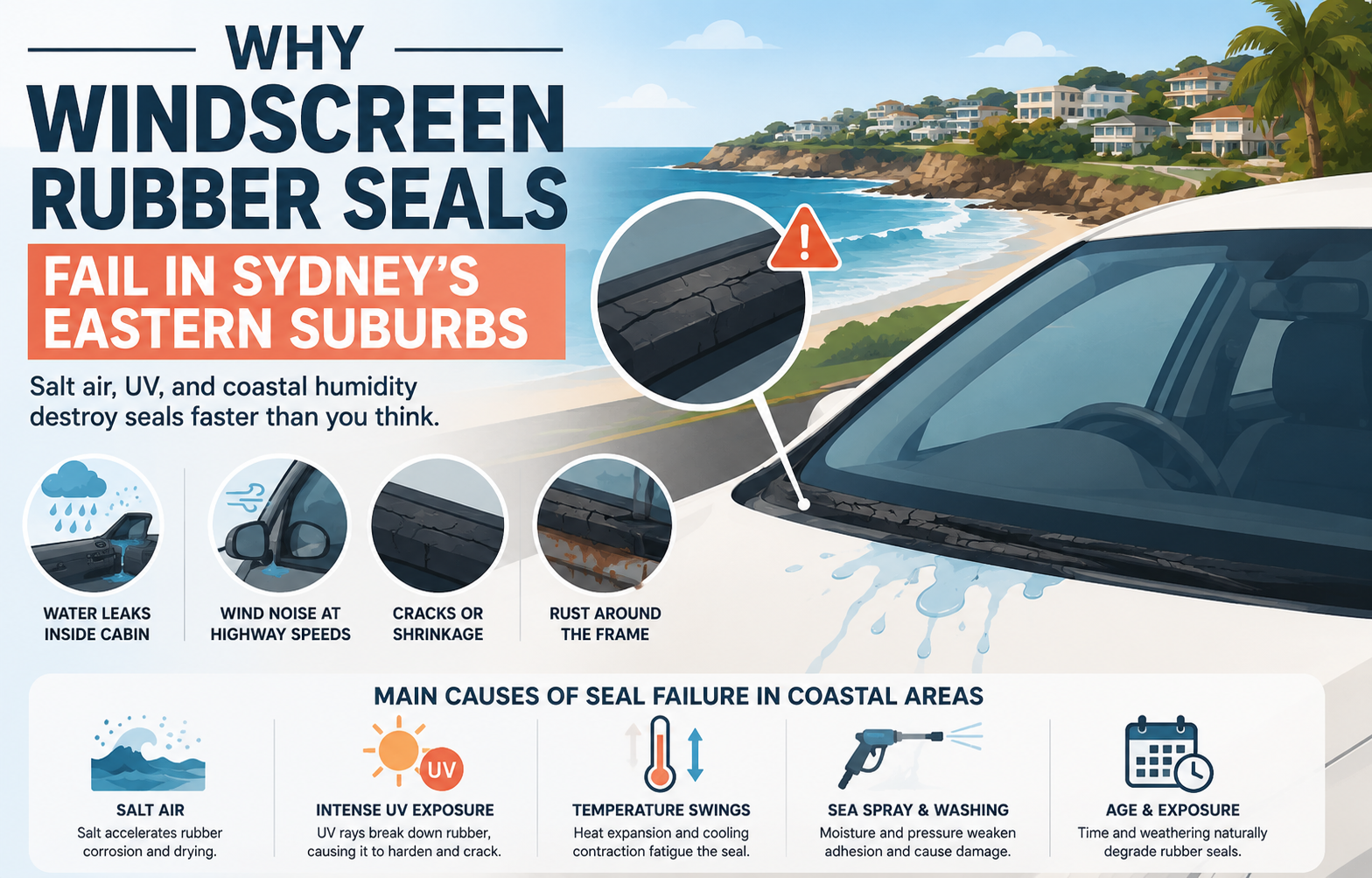
Salt air. The proximity to beaches, Bondi, Coogee, Maroubra, and Bronte, means a constant presence of salt in the air. Salt doesn't crack glass, but it accelerates the degradation of the rubber seal around the windscreen. When that seal perishes, moisture gets under the glass and weakens the bond over time.
Temperature swings. Warm sunny days followed by cooler sea breezes create thermal stress on the glass. A small chip that's survived a stable week can crack overnight after a hot day and cool evening.
Road conditions. Parts of the Eastern Suburbs have ageing road surfaces. The vibration from rough roads accelerates crack propagation from existing chips one reason why getting chip damage assessed quickly matters more here than in suburbs with newer infrastructure.
Coastal traffic density. More cars, more trucks, more delivery vehicles on narrow suburban streets means more loose aggregate getting kicked up from tyres. Beach parking areas in particular, where sand and small stones collect on road surfaces, are a common source of stone chips.
None of this means you'll inevitably damage your windscreen. But it does mean that when damage happens, acting on it quickly matters more here than in areas with more stable conditions.
Can Insurance Cover It?
Many comprehensive car insurance policies in NSW include windscreen repair or replacement cover, sometimes with no excess for repairs. If your policy has glass cover, a chip repair is usually fully covered, meaning it costs you nothing.
For replacement, most policies cover aftermarket glass by default. If you want OEM glass (original spec from your vehicle's manufacturer), you may need to pay the difference. This is worth checking before you authorise any work, because the conversation is much easier before the job starts than after.
A few things worth knowing about insurance and windscreens in NSW:
- Claiming a repair (as opposed to a replacement) typically doesn't affect your no-claims bonus under most policies, but always confirm this with your insurer first.
- Some policies require you to use an insurer-approved repairer. Others let you choose your own and reimburse you.
- If damage has spread because you delayed, some insurers may query whether the original damage was reported promptly.
The practical advice: check your policy before booking, or call your insurer when you first notice the damage. Five minutes on the phone before the job can save you an unexpected out-of-pocket cost.
Final Words
If the damage is small, away from the edges, and outside your direct line of sight, get a repair done today. Don't wait until the weekend. Sydney's Eastern Suburbs conditions make waiting costly, and a repair that's possible today may not be possible by tomorrow.
If the crack is long, near the edge, or directly in your vision, skip the repair conversation and book a replacement. Trying to repair damage that should be replaced is a false economy. The repair won't hold, and you'll be getting the replacement anyway in a few weeks.
If you're not sure which category your damage falls into, that's fine. That's what a free on-site assessment is for. At Eastern Suburbs Windscreens, our mobile technicians service Bondi, Randwick, Maroubra, Coogee, Mascot, Kensington, Rose Bay, and surrounding suburbs. We'll look at the damage, give you a straight answer on whether repair or replacement is the right call, and handle the job on the spot, at your home, your office, or wherever your car is parked.
Recent Posts